Author: Ilies, Horea

Francis Vasquez Wins Best Poster at IEEE ITherm 2026

Research from the Nanoscale Imaging and Transport Lab led by Prof. Georges Pavlidis points to a lower-cost way to keep next-generation power electronics cool.
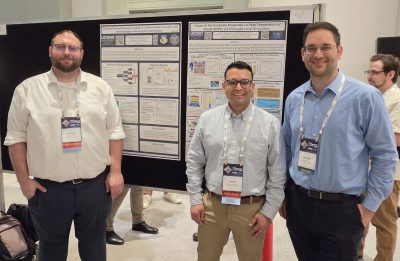
 

From left: Dominic Myren, Francis Vasquez, and Dr. Georges Pavlidis at ITherm 2026 in Orlando, Florida.

Francis Vasquez received the Best On-Site Poster Award in the component-level thermal management track at IEEE ITherm 2026, held May 26–29 in Orlando, Florida. He competed against 60 other students in the poster competition. His poster, “Impact of Die Substrate Properties on Peak Temperature of AlGaN HEMTs via Packaged-Level Simulation,” describes how to manage heat in a new class of high-power transistors.

Vasquez and fellow lab member Dominic Myren traveled to Orlando with the Nanoscale Imaging and Transport Lab, led by Dr. Georges Pavlidis, to present the group’s latest results on thermal management of microelectronics.

Why heat is the problem

Electric vehicles need faster charging, and AI data centers consume enormous amounts of power. Traditional silicon microchips are reaching their physical limits under those demands. The industry is turning to ultra-wide bandgap semiconductors such as aluminum gallium nitride, which allow smaller, faster, and more efficient devices that can operate at higher voltages.

The trade-off is heat. These high-power transistors generate so much of it that, without good cooling, they can fail early and become unreliable.

A cheaper path, and a thermal bottleneck

To make these devices affordable, the team is building them on sapphire, which costs about one-fifth as much as silicon carbide, the material commonly used today (based on 8-inch commercial wafers). Sapphire has a drawback, though: it conducts heat poorly, so it tends to trap it.

The work is part of the project “Advancing DoD High Power Systems: Transition of High Al% AlGaN from Lab to Fab,” carried out in collaboration with Analog Devices Inc. The goal is a device that delivers 50 watts of power while staying below 175 °C.

What the team found

Vasquez’s simulations showed that fine-tuning the microscopic layers inside the transistor does little to lower peak temperature in large commercial devices. The biggest gains come from the sapphire and the packaging around the chip:

  • Thinner sapphire: Reducing the substrate to 300 micrometers (about 0.3 millimeters) raised the device’s power output by 37%, from 43 to 59 watts, in the baseline model.
  • Better thermal interface materials: The material that bonds the chip package to the heat sink is the next critical choice. Metal-filled greases and graphene pads are promising options for limiting temperature rise.

What’s next

With the core thermal strategy validated at ITherm, the team will focus on miniaturization. They want to find out how small the device’s active area can get while the low-cost sapphire substrate stays thermally stable.


On the Right Track with Formula SAE Team

by Julie (Stagis) Bartucca ’10 (BUS, CLAS), ’19 MBA

Can Formula Racing Open Doors for Students?

The first time he visited UConn, it was pouring rain. It’s an understatement to say Jake Gannon was not sold on the University.

“After that, I didn’t really want to go to UConn,” says Gannon ’27 (ENG).

Still, he applied, was accepted, and gave UConn another chance at UConn Bound day, the open house for admitted students. UConn Formula SAE, a student organization that builds and races their own Formula-style cars, had a car on display on Fairfield Way. After talking to students in the group, the deal was sealed for Gannon, who aspires to a career in motorsports.

“I actually came here because of this club,” he says.

Today, Gannon is president of the organization, which this summer was the only U.S.-based team to place in the top 5 for both its electric and internal combustion vehicles at international competitions sponsored by SAE International, formerly known as the Society of Automotive Engineers.

Continue reading →

Prof. Chao Hu Named 2025 Associate Editor of the Year by the ASME Journal of Mechanical Design

chao hu
Prof. Chao Hu

The award recognizes sustained excellence in editorial service in the volume, quality, and speed of the peer review.

ME Associate Professor Dr. Chao Hu has been selected as a 2025 Associate Editor of the Year for the ASME Journal of Mechanical Design (JMD). The award recognizes Associate Editors who have made outstanding contributions to the journal in terms of the quantity, quality, and turnaround time of papers coordinated during the past year.

It is a distinction that says as much about the discipline of the work as the volume of it. Every paper an Associate Editor handles represents a chain of decisions, from identifying reviewers with the right expertise, to weighing conflicting recommendations, and returning a defensible verdict to authors who are often waiting on it for a degree, a grant renewal, or a tenure case. Doing that well, at scale, and quickly is a form of service that rarely announces itself. JMD’s award exists precisely to make it visible.

Dr. Hu is the Collins Aerospace Professor in Engineering Innovation and an Associate Professor in the School of Mechanical, Aerospace, and Manufacturing Engineering at UConn. He has served as an Associate Editor for JMD since 2022 and is currently serving his second three-year term.

A long record of service

Hu has a long record of service to ASME and the design automation community. He has been a member of the ASME Design Automation Executive Committee since 2021. His service to JMD began well before his appointment as an Associate Editor: he has been a regular reviewer for the journal since 2011 and received the ASME Reviewers of the Year Award in 2019.

The fourteen-year time frame, from first-time reviewer to award-winning editor, traces a path that is increasingly rare and increasingly needed. Peer review depends on researchers who are willing to invest in a journal over the long term, and Hu’s history with JMD reflects that kind of commitment to the field’s shared infrastructure.

Research at the intersection of design and uncertainty

Prof. Hu’s research focuses on engineering design under uncertainty, battery health diagnostics and prognostics, and machine and structural health monitoring. The through-line across these areas is a practical one: engineered systems degrade, operating conditions vary, and models are imperfect. His work develops methods for designing and monitoring systems that must perform reliably anyway, which is a task with direct consequences for electrified transportation, aerospace structures, and manufacturing equipment alike.

At UConn, he is part of a strong design group in Mechanical Engineering that consists of more than 10 tenure-track faculty, giving the school unusual depth in design theory, optimization, and reliability.

In addition to his role with JMD, Hu serves as a Senior Editor for Engineering Optimization and as a Review Editor for Structural and Multidisciplinary Optimization.

Continue reading →

Chang Liu Receives Prestigious NSF CAREER Award

by

His research could improve the efficiency and reliability of technologies ranging from aircraft and transportation systems to electronics cooling and data centers

chang liu
Professor Chang Liu. (Christopher LaRosa/UConn Photo)

Mechanical engineering assistant professor Chang Liu has received a prestigious Faculty Early Career Development (CAREER) Award from the National Science Foundation (NSF), the agency’s highest honor supporting early-career faculty who demonstrate exceptional potential as both researchers and educators.

The award recognizes Liu’s innovative work at the intersection of fluid dynamics, nonlinear systems, and control theory while supporting a research and education program that could improve the performance and efficiency of technologies ranging from aircraft to data centers.

Liu’s project, “CAREER: Nonlinear Stability, Input-Output Analysis, and Control of Time-Varying Wall-Bounded Shear Flows,” will develop new mathematical frameworks to better understand fluid flows that change over time, a longstanding challenge in engineering that affects everything from transportation and energy systems to electronics cooling.


Continue reading →

Anna Tarakanova Recognized by ASME For Early Career Achievements

Her central contribution is the development of rigorous multiscale frameworks that connect molecular structure, statistical mechanics, and macroscopic behavior across complex materials.


Tarakanova was selected to receive the Sia Nemat-Nasser Early Career Award. (Christopher LaRosa/UConn Photo)

The American Society of Mechanical Engineers (ASME) has recently recognized a UConn College of Engineering faculty member for her early career contributions in advancing mechanical characterization and multiscale description of biomaterials.

School of Mechanical, Aerospace, and Manufacturing Engineering associate professor Anna Tarakanova was selected to receive the Sia Nemat-Nasser Early Career Award.

The award recognizes early career research excellence in the areas of experimental, computational, and theoretical mechanics and materials. Young investigators (within 10 years after their Ph.D. degree) are honored with this award, which also has a special emphasis placed on under-represented groups.

Offered through ASME, the award was established in 2008 by their materials division.


Continue reading →

Seung Yeon’s NSF CAREER Award in Micro- and Nanoscale Manufacturing

by

SeungYeon Kang has received a prestigious NSF CAREER Award for her work on transforming how microscopic electronic devices are built.

Sally Kang
SeungYeon Kang. (Christopher LaRosa/UConn Photo)

SeungYeon Kang, an assistant professor in the UConn School of Mechanical, Aerospace, and Manufacturing Engineering, is working to transform how microscopic electronic devices are built. This research could help power a new generation of smaller, faster, and more efficient technologies.

Kang has received a prestigious National Science Foundation (NSF) CAREER Award for her project, “3D One-step Heterogeneous Manufacturing for Integrated Circuits (3D OHMIC).” This award will help support her research on advanced manufacturing processes that operate at the micro and nanoscale.

“At its core, this project is simple but fundamental,” says Kang. “We build most electronics in flat, two-dimensional layers, even though the world around us is three-dimensional. This makes devices harder to miniaturize, slower to produce, and more resource-intensive.”


Continue reading →

Farhad Imani Wins NSF CAREER Award to Build Manufacturing Systems That Think

by

Automation dominates modern factories, but much of it still breaks when parts vary, damage is uncertain, and expert judgement is required. Farhad Imani’s project targets this failure by developing robotic manufacturing systems that can sense change and adapt in real time.


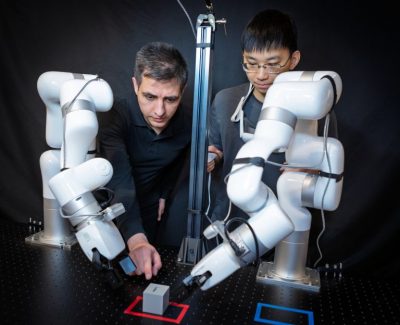
Professor Imani and 3rd year Ph.D. student, Zhiling Chen, working with robotic arms in his lab. (UConn Photo/Chris LaRosa)

A critical challenge is emerging in manufacturing: how to repair and restore high-value components when current systems can’t handle deviation. Factories are full of automation systems that perform well when processes are repetitive. The moment geometry shifts, the process changes, or defects evolve, they struggle.  

NSF CAREER Award recipient Farhad Imani, an assistant professor in mechanical engineering at the University of Connecticut, is tackling this challenge head-on through the development of a new class of intelligent robotic manufacturing systems that can inspect parts, interpret multimodal sensor data, and reason through uncertainty. 


Continue reading →

Embracing Uncertainty For Stronger Engineering Systems

Many real-world systems—from materials to infrastructure—contain a mix of order and randomness, a concept known as stochasticity


Students and faculty involved in the stochasticity research (Contributed photo).

A few years after receiving the National Science Foundation Early CAREER Award, UConn College of Engineering Assistant Professor Hongyi Xu is demonstrating how embracing uncertainty can lead to stronger, smarter engineering systems. 

Xu’s research focuses on a simple, but challenging, fact, which is that not everything in engineering is perfectly uniform. Many real-world materials contain a mix of order and randomness, a concept known as stochasticity. Rather than designing around that uncertainty, Xu has developed new computational tools that allow engineers to use it intentionally, and combine it seamlessly with ordered materials. 

Continue reading →

MAM Alum Powers Performance at McLaren Racing

by
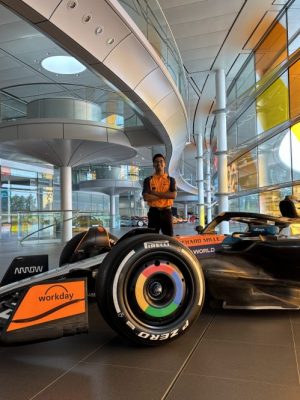
Abhiemanyu Sukumaran in the McLaren F1 Technology Centre in Woking, Surrey, England (Contributed photo).

Abhiemanyu Sukumaran ’24 (ME) landed his dream job as a Performance Analysis Engineer at McLaren Racing after serving as president of UConn Formula SAE for two years.

When Abhiemanyu Sukumaran ’24 (ENG) attended his first virtual meeting for UConn Formula SAE, he had no idea it would redefine his future. What began as curiosity during the COVID era quickly became a passion—and ultimately a launchpad into the pinnacle of motorsport.

Today, Sukumaran is a Performance Analysis Engineer at the McLaren F1 Team, helping prepare championship-contending cars and drivers for races around the world.

In his role at McLaren Racing, Sukumaran works at the crossroads of car performance, driver performance, and future vehicle development. As he puts it, performance analysis engineers are effectively “the race engineers at the factory.”

Continue reading →