Research

Chang Liu Receives Prestigious NSF CAREER Award

by

His research could improve the efficiency and reliability of technologies ranging from aircraft and transportation systems to electronics cooling and data centers

chang liu
Professor Chang Liu. (Christopher LaRosa/UConn Photo)

Mechanical engineering assistant professor Chang Liu has received a prestigious Faculty Early Career Development (CAREER) Award from the National Science Foundation (NSF), the agency’s highest honor supporting early-career faculty who demonstrate exceptional potential as both researchers and educators.

The award recognizes Liu’s innovative work at the intersection of fluid dynamics, nonlinear systems, and control theory while supporting a research and education program that could improve the performance and efficiency of technologies ranging from aircraft to data centers.

Liu’s project, “CAREER: Nonlinear Stability, Input-Output Analysis, and Control of Time-Varying Wall-Bounded Shear Flows,” will develop new mathematical frameworks to better understand fluid flows that change over time, a longstanding challenge in engineering that affects everything from transportation and energy systems to electronics cooling.


Continue reading

Anna Tarakanova Recognized by ASME For Early Career Achievements

Her central contribution is the development of rigorous multiscale frameworks that connect molecular structure, statistical mechanics, and macroscopic behavior across complex materials.


Tarakanova was selected to receive the Sia Nemat-Nasser Early Career Award. (Christopher LaRosa/UConn Photo)

The American Society of Mechanical Engineers (ASME) has recently recognized a UConn College of Engineering faculty member for her early career contributions in advancing mechanical characterization and multiscale description of biomaterials.

School of Mechanical, Aerospace, and Manufacturing Engineering associate professor Anna Tarakanova was selected to receive the Sia Nemat-Nasser Early Career Award.

The award recognizes early career research excellence in the areas of experimental, computational, and theoretical mechanics and materials. Young investigators (within 10 years after their Ph.D. degree) are honored with this award, which also has a special emphasis placed on under-represented groups.

Offered through ASME, the award was established in 2008 by their materials division.


Continue reading

Seung Yeon’s NSF CAREER Award in Micro- and Nanoscale Manufacturing

by

SeungYeon Kang has received a prestigious NSF CAREER Award for her work on transforming how microscopic electronic devices are built.

Sally Kang
SeungYeon Kang. (Christopher LaRosa/UConn Photo)

SeungYeon Kang, an assistant professor in the UConn School of Mechanical, Aerospace, and Manufacturing Engineering, is working to transform how microscopic electronic devices are built. This research could help power a new generation of smaller, faster, and more efficient technologies.

Kang has received a prestigious National Science Foundation (NSF) CAREER Award for her project, “3D One-step Heterogeneous Manufacturing for Integrated Circuits (3D OHMIC).” This award will help support her research on advanced manufacturing processes that operate at the micro and nanoscale.

“At its core, this project is simple but fundamental,” says Kang. “We build most electronics in flat, two-dimensional layers, even though the world around us is three-dimensional. This makes devices harder to miniaturize, slower to produce, and more resource-intensive.”


Continue reading

Farhad Imani Wins NSF CAREER Award to Build Manufacturing Systems That Think

by

Automation dominates modern factories, but much of it still breaks when parts vary, damage is uncertain, and expert judgement is required. Farhad Imani’s project targets this failure by developing robotic manufacturing systems that can sense change and adapt in real time.


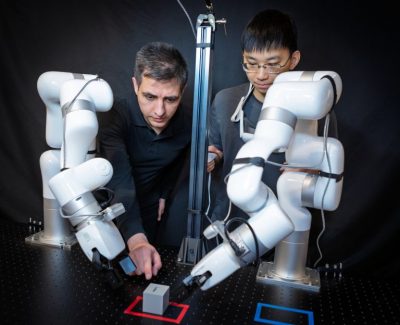
Professor Imani and 3rd year Ph.D. student, Zhiling Chen, working with robotic arms in his lab. (UConn Photo/Chris LaRosa)

A critical challenge is emerging in manufacturing: how to repair and restore high-value components when current systems can’t handle deviation. Factories are full of automation systems that perform well when processes are repetitive. The moment geometry shifts, the process changes, or defects evolve, they struggle.  

NSF CAREER Award recipient Farhad Imani, an assistant professor in mechanical engineering at the University of Connecticut, is tackling this challenge head-on through the development of a new class of intelligent robotic manufacturing systems that can inspect parts, interpret multimodal sensor data, and reason through uncertainty. 


Continue reading

Embracing Uncertainty For Stronger Engineering Systems

Many real-world systems—from materials to infrastructure—contain a mix of order and randomness, a concept known as stochasticity


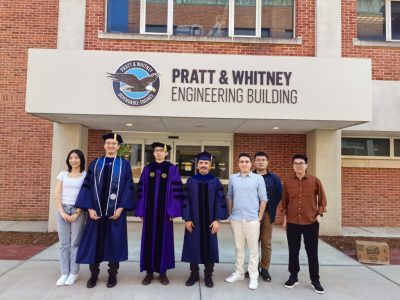
Students and faculty involved in the stochasticity research (Contributed photo).

A few years after receiving the National Science Foundation Early CAREER Award, UConn College of Engineering Assistant Professor Hongyi Xu is demonstrating how embracing uncertainty can lead to stronger, smarter engineering systems. 

Xu’s research focuses on a simple, but challenging, fact, which is that not everything in engineering is perfectly uniform. Many real-world materials contain a mix of order and randomness, a concept known as stochasticity. Rather than designing around that uncertainty, Xu has developed new computational tools that allow engineers to use it intentionally, and combine it seamlessly with ordered materials. 

Continue reading

Nguyen’s Injectable Piezoelectric Gel Could Treat Osteoarthritis without Surgery

Backed by a $2.3M grant from the NIH and NIH/NIBIB, Thanh Nguyen will stimulate cartilage regeneration in large animal model.

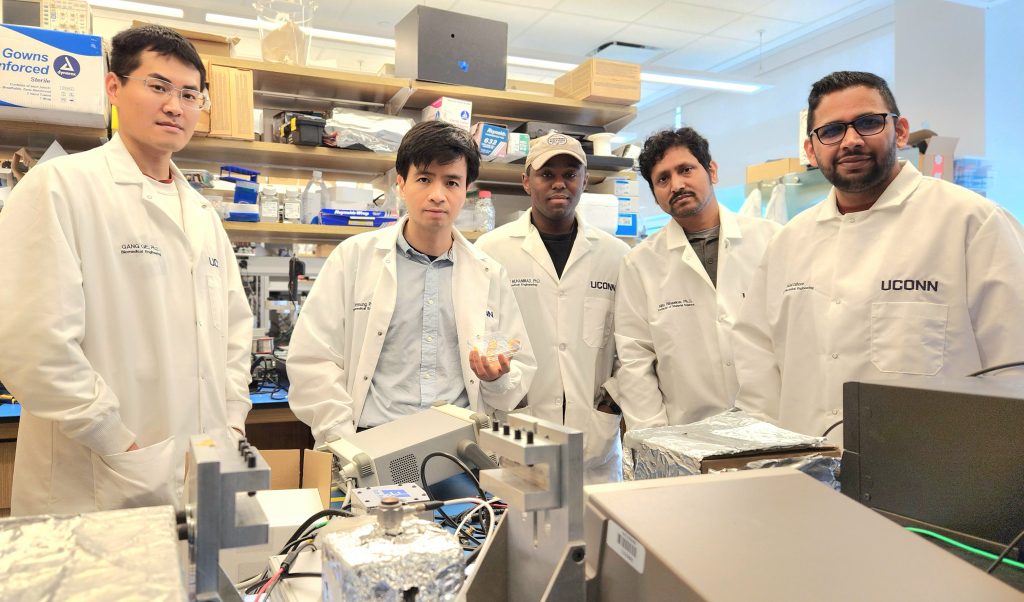
A team from the College of Engineering is developing an injectable hydrogel that could stimulate cartilage regeneration in large animal models. The work recently was supported by a $2.3M grant. Pictured, from left, is postdoctoral fellow Gang Ge, Associate Professor Thanh Nguyen, Ph.D. candidate I'jaaz Muhamaad, postdoctoral fellow Sumanta Karan, and Ph.D. candidate Achal Duhoon.(Contributed photo)
A team from the College of Engineering is developing an injectable hydrogel that could stimulate cartilage regeneration in large animal models. The work recently was supported by a $2.3M grant. Pictured, from left, is postdoctoral fellow Gang Ge, Associate Professor Thanh Nguyen, Ph.D. candidate I’jaaz Muhamaad, postdoctoral fellow Sumanta Karan, and Ph.D. candidate Achal Duhoon.(Contributed photo)

Millions of Americans suffer from osteoarthritis, a painful joint disease that wears down cartilage and can severely impact mobility. Pain medications only mask symptoms, and surgical option carry risks of infection and immune rejection.

At the University of Connecticut, a research team led by Thanh Nguyen, associate professor of mechanical engineering and biomedical engineering, believes the future of joint repair might lie in a tiny electrical spark—and a simple injection.

Backed by a $2.3M grant from the National Institutes of Health (NIH) and National Institute of Biomedical Imaging and Bioengineering (NIBIB), Nguyen and his team are developing an injectable hydrogel designed to stimulate cartilage regeneration in large animal models.

“With current treatments, we’re managing the pain, not healing the tissue,” says Nguyen. “We’re hoping that the body’s own mechanical movements—like walking—can generate tiny electrical signals that encourage cartilage to grow back.”

The innovation harnesses the body’s natural bioelectric signals to promote healing. The injectable gel contains a piezoelectric scaffold—a composite made from biodegradable poly-L-lactic acid (PLLA) nanofibers and magnesium oxide nanoparticles. When subjected to mechanical stress—such as joint movement or ultrasound—this scaffold generates small electrical charges.

Continue reading

DREAM Engineering: Where Research Meets Imagination

The D2REAM Research Center team is continuing its work supporting advanced structural digital design and manufacturing, and discovery of novel metamaterials. (Christopher LaRosa / UConn College of Engineering Photo)

The University of Connecticut’s Digital Design Research, Analysis, and Manufacturing (D2REAM) Center has received a second round of funding to continue its work supporting advanced structural digital design and manufacturing, and discovery of novel metamaterials.

The funding is aimed at continuing academic, government, and industry partnerships that are developing groundbreaking modeling and simulation capabilities that can support the next generation of Army ground vehicle systems.

The $5 million in new federal government funding comes from a cooperative agreement with the United States Army Combat Capabilities Development Command (DEVCOM) Ground Vehicle Systems Center (GVSC) in Warren, Michigan. GVSC maintains collaborations with higher education, defense and automotive industry parties to co-develop key ground vehicle technologies.

Continue reading

George Matheou’s Art on Display at the National Academy of Sciences

Clouds strongly interact with solar radiation and as a result small changes in cloud cover have big impact on the Earth’s surface temperature. Currently, the effects of clouds are one of the largest sources of uncertainty in climate projections.

george matheou standing next to video projection
Georgios Matheou, associate professor of mechanical engineering, stands by his video projection at the National Academy of Sciences. The exhibit, “Chaosmosis: Assigning Rhythm to the Turbulent” is on display through Feb. 23.

Recent computer technology, however, is enabling scientists and engineers to create cloud simulations in controlled environments.

Georgios Matheou, associate professor of mechanical engineering in the School of Mechanical, Aerospace and Manufacturing Engineering, is using a mathematical model called large-eddy simulation to replicate cloud physics and create cloud models. These simulations help improve weather forecasts and climate projections while contributing to the field of fluid dynamics—a discipline that describes the flow of liquids and gases.

Read more in the UConn Today article.

Gel Repairs Cartilage Without Surgery, With Electricity

Instead of requiring surgery to insert a solid scaffold, the gel could be simply injected into the knee, a much less invasive procedure

Prof. Thanh Nguyen (right) and graduate student Tra Vinikoor (left).

A lifetime of activity can gradually erode the cartilage that cushions our joints. Someday, we might simply inject a gel to repair it, University of Connecticut researchers report in the Oct. 6 issue of Nature Communications.

Read more by following the link below:
Continue reading