Mechanical Engineering Demos Shine at the Capitol
On Thursday, April 11th, a dedicated team of students and faculty demonstrated and discussed innovative “home grown” engineering prototypes at the Connecticut State Capitol during a rally in support of Governor Dannel P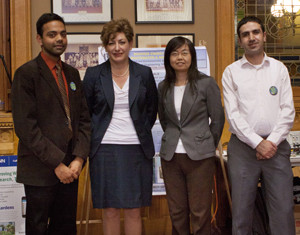 . Malloy’s proposed Next Generation Connecticut.
Next Generation Connecticut is aimed at reenergizing and redefining Connecticut’s economy through strategic investments in science, technology, engineering, and math disciplines (STEM) at UConn. The bill, which is making its way through the legislative process, was passed overwhelmingly by the Finance, Revenue and Bonding Committee on April 16th.
Among the featured speakers were Gov. Malloy, UConn President Susan Herbst, UConn Provost Mun Y. Choi, elected officials, labor and business council leaders, as well as two outspoken executives from Connecticut businesses: Robert Friedland, co-founder, president, and CEO of Wallingford-based Proton OnSite; and Ed Murphy, Senior Director of Technology Planning and Intellectual Property at JDS Uniphase in Bloomfield.
But for many attendees, the most compelling demonstration of why Connecticut should invest in UConn’s STEM programs was evidenced by the array of extraordinary projects designed and developed by UConn students and faculty members. The selection of UConn Engineering projects displayed included a custom test stand for a common surgical implement, a fuel cell-powered model vehicle, unmanned autonomous aerial and land vehicles, a microbial fuel cell, and 3D manufacturing apparatus. The projects and demonstrators are summarized below. See photos here.
Surgical Tool Test Device
For their senior-year design project, Biomedical Engineering students Kathryn Dobler, John Burke and Jordy Schuller designed and built a custom, prototype testing device for a Covidien product, the Premium Surgiclip™, used to clamp off blood vessels during surgery. A hand-held, stapler-like device is used to apply the clip during surgery. The medical equipment giant Covidien tasked the students to develop a fixture capable of performing several different tests to determine the force applied by the clip dispenser and its effect on the clip. The testing unit is integrated within a machine that tests for tensile, compression, fatigue, impact and hardness, with the measures displayed on an attached computer screen. The students explained that the ultimate goal of the project is to establish a clinically acceptable product specification that can be measured and evaluated.
Hydrogen-Powered Fuel Cell Car
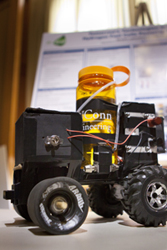 Seniors Nicholas Morse and Leia Dwyer, with their advisor, Dr. William Mustain (Chemical & Biomolecular Engineering) demonstrated “The Chegger,” a model car that runs on a hydrogen-powered fuel cell. The car was developed for an American Institute of Chemical Engineers-sponsored competition, ChemECar. Entries must rely on chemical reactions to power the motor and stop the car. The Chegger employs a light-activated electronic circuit incorporating an iodine chemical reaction to stop the car. For the ChemECar competition, vehicles must travel a fixed distance while carrying a payload, but the distance and weight requirements are not revealed to teams until competition day. Dr. Mustain and his research team are making advances in the area of electrocatalyst materials for energy conversion and storage, and in enhancing our understanding of the fundamental science behind fuel cell technology, that may contribute to the future of fuel cell applications in energy.
Autonomous Vehicles [View a video here]
 Mechanical Engineering students Roseanna Warren, Yuqian Liu, Jiaxing Che and Robert Herman, accompanied by their advisor, Dr. Chengyu Cao, showcased prototype autopilots along with quad-copter and helicopter models – unmanned autonomous vehicles designed and constructed in the Adaptive Systems, Intelligence and Mechatronics (AIM) Lab. Dr. Cao’s lab is developing novel control algorithms to enable the vehicles to adapt to local and environmental uncertainties, such as obstacles and varying terrain. The team is also linking the vehicle control systems into networks that allow for more complex interactions among the vehicles. Other focuses include the auto-pilot technology and circuits that host the control and navigation algorithms. The team’s work will improve the robustness and adaptive capabilities of unmanned vehicle networks.
Benthic Microbial Fuel Cell (BMFCs)
Graduate students Udayarka Karra (Civil & Environmental Engineering) and Ridvan Umaz (Electrical & Computer Engineering), accompanied by Dr. Baikun Li (Civil & Environmental Engineering), demonstrated two bench-scale microbial fuel cells that generate electricity through the metabolic activity of anaerobic bacteria and the decay of organic matter found in the top layer of sediment in bodies of water. The research team anticipates these devices may provide a steady power supply for remote oceanographic devices used in sensing and monitoring ocean environments. A focus is on developing a distributed network to address the energy supply problems for underwater sensor network applications. Dr. Li and her team are exploring and testing various facets of the technology, including novel electrode materials, BMFC configurations, power management schemes, and microbial ecology analysis to enhance understanding of the various aspects related to underwater bioenergy conversion.
3D Manufacturing
Sonya Renfro, Program Coordinator for Diversity & Outreach, and junior Monica Smith (Mechanical Engineering and German) demonstrated 3D printing using a desktop device in which a three-dimensional object is built layer-by-layer using a plastic material. The device is one of two used by UConn’s Engineering Ambassadors in outreach visits to middle and high school students aimed at exciting the students in engineering as a fun and creative career choice. Often used for rapid-prototyping of highly complex geometries, 3D printing begins with a digital CAD design, which software interprets as a series of thin horizontal slices. The 3D printer then builds the actual shape in successive layers. Inexpensive machines are now being used to produce sculptures, machine parts, jewelry, home furnishings, and medical implants. 3D printing is related to the more complex additive manufacturing technologies underway at UConn’s recently announced Pratt & Whitney Additive Manufacturing Innovation Center, which hosts state-of-the-art Arcam electron beam devices that are suitable for manufacturing large, complex metal parts from a range of different materials at high temperature.
Published: April 24, 2013
 She returned to UConn for what would have been her senior year and began studying mechanical engineering. Monica didn’t completely leave Germany behind, though – she currently lives in McMahon Hall as an active member and resident assistant of the Eurotech learning community.
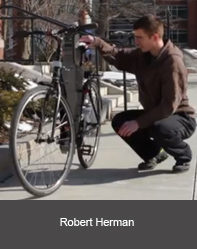 “I was tired of pedaling all the time. Initially, I thought about a scooter, but parental pressure nixed that idea. I ultimately decided to retrofit my bike, a Trek 7.2 FX.”
 Doctoral candidates Lu Han and
  stream ready for sequestration. While there may be economic costs associated with mandating carbon capture, it will generate a source of stable, clean energy in the long-term.”
 Conductivity,” Professor Anson Ma and colleagues from Rice University detail their recent breakthrough revolutionizing the use of carbon nanotubes. Carbon nanotubes (CNTs) are rolled cylinders of graphene sheets that have unprecedented mechanical, electrical, and thermal properties. In the past, many of the potential real-world applications of CNTs remained unfulfilled because researchers experienced great difficulties dispersing and processing CNTs into macroscopic objects while maintaining their fascinating properties. To address this problem, Dr. Ma and colleagues from Rice developed a scalable fluid-based process for spinning CNTs into lightweight and multifunctional fibers. These fibers combine the mechanical strength of carbon fibers with the specific electrical conductivity of metals, opening up the exciting possibility of using CNTs in aerospace, field-emission, and power-transmission applications. The article can be accessed at:
 Dr. Lee S. Langston, professor emeritus of Mechanical Engineering, recently published columns in
  Science Foundation grant, recently received travel grant funding from the NASA
  In response to the unfathomable Sandy Hook Elementary School tragedy in Newtown, CT last month, one of UConn Engineering’s own, Sharon L. McDermott, a Program Coordinator in the Undergraduate Program Office, joined a team of handlers and registered therapy dogs during the holidays to bring comfort to children and adults dealing with the trauma of that horrific event. The group, which is associated with the
  On October 27, 2012, faculty and staff from the Mechanical Engineering (ME) Department hosted a gathering of approximately 60 ME alumni, friends and emeriti faculty members. The day’s events combined informative and social activities, and included presentations by Department Head Baki Cetegen and Provost Mun Y. Choi, who is a professor of Mechanical Engineering as well as UConn’s chief academic officer.
 Dr. Chengyu Cao sees a day in the not-so-distant future when intelligent robots will be working alongside humans on a wide range of important tasks from advancing science, to performing deep sea rescues, to monitoring our natural habitats. It’s a bold leap from the pre-programmed factory robots and remote-controlled drones we are most familiar with today. Cao, an assistant professor of mechanical engineering, and his research team are creating a new generation of smart machines – devices that are fully autonomous and capable of navigating their way through our complex world unassisted. These machines will not only be able to travel untethered from one point to another in space and perform tasks; they will be able to “think” on their own using artificial intelligence to adjust to unforeseen obstacles and situations in their environment – a tree, a building, a sudden gust of wind or change in tidal current – without human interface. It is the stuff of which science fiction movies are made. Read the full story, and watch the exciting video,
  Photovoltaic cells are made of semiconducting materials such as silicon. When light strikes the cell in the form of photons, some portion of the spectrum is absorbed by the semiconductor material, transferring energy to the semiconductor. In the process, electrons are released from their bonds and allowed to flow freely; in this fashion, sunlight is transformed into usable energy.
 The team’s reputation led to one particularly interesting episode. President Carter was dedicated to the idea of reducing not only the nation’s, but also his personal reliance on foreign oil. So in 1979, as he announced an ambitious energy goal for the U.S. – 20 percent of the nation’s energy use from solar by the year 2000 – President Carter installed four banks of eight panels on the roof of the White House to provide hot water to the Oval Office dining room. The panel manufacturer was a Connecticut company that knew of UConn’s solar certification program, and soon the General Services Administration awarded the job of testing and balancing to Dave Jackson and Mike Boyle. Dr. Boyle says the testing involved performing various efficiency measurements, including temperature, flow rate and the like. The experience proved interesting to both men, who recall being shadowed by Secret Service men for the duration of their testing and balancing efforts.