Hybrid Bike: Optimizing Pedal Power (VIDEO)
Junior Robert Herman (Mechanical Engineering) is a serial tinkerer. Between Thanksgiving and Christmas, he converted a bicycle into a hybrid electric/pedal bike to manage the five miles of hilly terrain between his home in Coventry and the UConn campus.
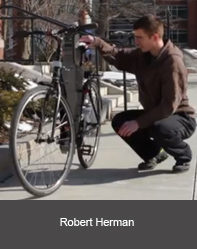 “I was tired of pedaling all the time. Initially, I thought about a scooter, but parental pressure nixed that idea. I ultimately decided to retrofit my bike, a Trek 7.2 FX.”
Using a CAD program to design the apparatus, Robert says “Most hybrid bikes use a hub motor. I decided to place mine with the crankset so it could benefit from the bike’s transmission. I watched some YouTube videos to familiarize myself with different options for converting bikes into hybrids; I learned there are no standard components or methods, so I had to improvise on my own. Also, in the original design, I was going to build force-feedback pedals, but I scrapped it in lieu of a simple knob to vary speed.”
Like electric cars, the hybrid bike is remarkably quiet and gets great mileage: about 15-25 miles per charge. The assembly includes a lithium iron phosphate (LiFePO4) rechargeable battery, motor with a re-wound armature for enhanced power, motor driver, speed controller, 24 volt charger and battery management system that balances the battery voltage. After assembling and testing the bike, Robert enclosed everything in an aluminum casing that he machined himself, adding weather stripping to prevent moisture from seeping into the pristine assembly.
Unlike most UConn Engineering students, who arrive on campus with degrees from traditional high schools, Robert is a graduate of Windham Technical High School. While he trained for the HVAC trade at Windham Tech, Robert taught himself machining technology and developed more advanced skills in the design and construction of complex machines. Robert thrives on “projects” and always has at least one underway. He confesses that movies are a source of many ideas, and games flexed his creative aptitude. Most projects are executed in the family basement/design workshop.
This school year, Robert has worked in the Adaptive Systems, Intelligence and Mechatronics Laboratory of Dr. Chengyu Cao. Robert contributes toward the design and manufacture of a prototype autonomous underwater vehicle (AUV), along with the mechanical and some electrical components – including the AUV’s circuit boards and wire components – on the testing platform.
He also conducts independent research within the AIM lab. During the fall semester, he learned a programming language and began to develop code intended to direct a Nao humanoid robot to walk. His current efforts focus on a four-legged spider robot. For this project, he has developed a stereoscopic camera setup with the aim of converting the camera’s two-dimensional images into three dimensions so the robot can effectively navigate a room.
Robert’s mechanical inclinations and love of hands-on work underscore his career aspirations. As the engineer that he is training to become, he remarks, “After I graduate, I want to be a tinkerer.”
 Doctoral candidates Lu Han and
  stream ready for sequestration. While there may be economic costs associated with mandating carbon capture, it will generate a source of stable, clean energy in the long-term.”
 Dr. Chengyu Cao sees a day in the not-so-distant future when intelligent robots will be working alongside humans on a wide range of important tasks from advancing science, to performing deep sea rescues, to monitoring our natural habitats. It’s a bold leap from the pre-programmed factory robots and remote-controlled drones we are most familiar with today. Cao, an assistant professor of mechanical engineering, and his research team are creating a new generation of smart machines – devices that are fully autonomous and capable of navigating their way through our complex world unassisted. These machines will not only be able to travel untethered from one point to another in space and perform tasks; they will be able to “think” on their own using artificial intelligence to adjust to unforeseen obstacles and situations in their environment – a tree, a building, a sudden gust of wind or change in tidal current – without human interface. It is the stuff of which science fiction movies are made. Read the full story, and watch the exciting video,